Deep Dish Dungeon local coop: Couch Play Not Listed
Steam does not list Deep Dish Dungeon local coop. Online co-op supports three players. See what same-room groups can do instead.
Searching for Deep Dish Dungeon local coop usually means one couch, one screen, and two controllers. Deep Dish Dungeon local coop is not how the shipped game is labeled. That mismatch matters on a $14.99 launch, because a couch group can buy before noticing the session is online only.
Behold Studios and Raw Fury released the game on October 13, 2026. The Deep Dish Dungeon page on Steam calls it a survival exploration game through a hand-crafted, puzzle-heavy dungeon, playable solo or in online co-op. The feature row lists single-player, online co-op, and cross-platform multiplayer. It does not list split-screen, shared-screen, or couch co-op.
What the store page actually confirms
Official copy is consistent. You explore alone or with up to two friends, so the party cap is three. Co-op is framed as connecting, sharing what you learn, and keeping each other alive, not as a race for loot. Co-Optimus lists a co-op campaign and drop-in/drop-out for the PC version, and repeats the same “up to two friends” limit. It does not tag this game as couch co-op.
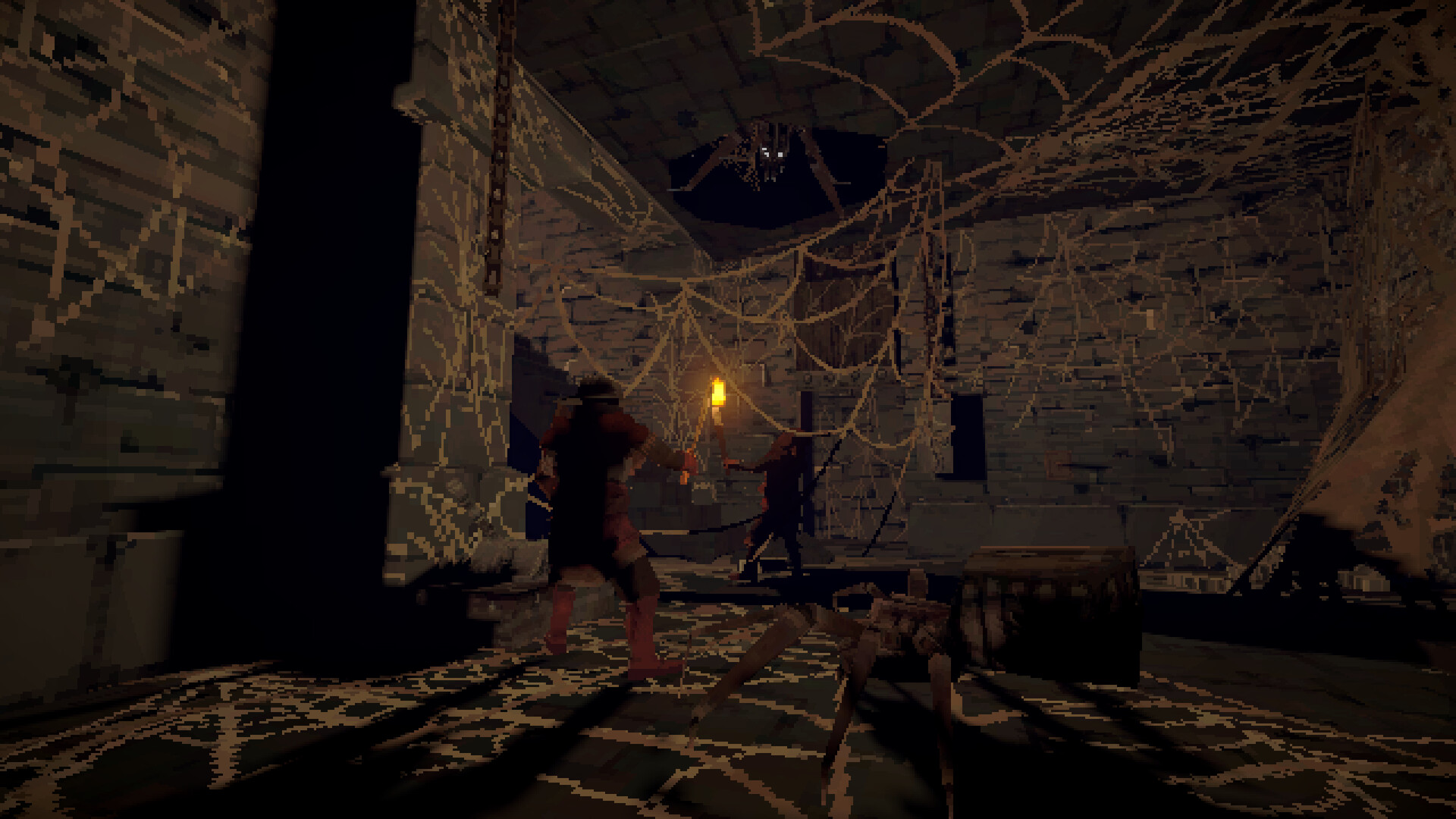
Official screenshot · Source: Steam store
Broadband internet is a minimum and recommended requirement on both Windows and macOS. That supports online play. It does not prove a LAN-only or offline same-PC mode.
| What you hoped to find | What these sources list | Status |
|---|---|---|
| Split-screen on one PC | Not in the Steam feature row | HOLD — not listed |
| Two controllers, one TV | No couch or local mode named | HOLD — not listed |
| Online co-op | Steam feature; up to two friends | Confirmed |
| Cross-platform multiplayer | Steam feature | Confirmed; non-PC storefronts are not named here |
| Co-op campaign | Co-Optimus | Listed |
| Drop in / drop out | Co-Optimus | Listed |
| Offline local or LAN-only | Not described | HOLD — unknown |
Steam also lists achievements, Steam Cloud, and Family Sharing. Family Sharing does not, by itself, document a local session. Whether two household accounts can run the game at the same time is not spelled out in these sources. Treat that as unknown until you test it on your own library rules.
An introductory 15% discount was listed at $12.74, down from $14.99, through October 27, 2026. A demo is offered on the same store page. All reviews sat at Mostly Positive: 76% of 114 reviews on the page captured for this article. That score will move.
How a same-room group can still play
If Deep Dish Dungeon local coop is a hard requirement, stop before checkout. Nothing in the Steam feature list or the Co-Optimus extras gives you one machine and two gamepads.
A same-room night still works as three separate online clients:
- Three people is the ceiling: you plus two friends.
- Each person needs a machine that meets the spec and a copy they can launch.
- Each machine needs broadband, per the system requirements.
- Cross-platform multiplayer is advertised. These sources only print PC requirements for Windows 10 or 11 and for Mac. Do not assume a console version from the “cross-platform” badge alone.
- In-game chat and online interactivity are listed under content descriptors. Use them when someone is in another room, or when voice apps fail.
- Drop-in/drop-out, per Co-Optimus, is the closest official answer to “can the third person join after we start?” Exact menu steps are not printed on that page.
| Role in a 3-player night | Practical setup | Do not assume |
|---|---|---|
| Host | Owns the session on a PC that stays online | That a second controller joins the same exe |
| Friend 1 | Own PC or Mac, own login, broadband | That Family Sharing equals a second local player |
| Friend 2 | Same as friend 1; party is full at three | A fourth player, spectator slot, or local guest |
| Same couch, visually | Three screens or a shared display of three windows you arrange yourselves | Official split-screen or shared camera |
Windows minimums are a 64-bit OS, Windows 10 or 11, an Intel Core i3 or better, 8 GB RAM, DirectX 11-class graphics, broadband, and 2 GB of disk space. Recommended jumps to a Core i5, 16 GB RAM, and a GTX 580 / HD 7870 class GPU or newer. Mac minimums mirror the CPU, RAM, network, and storage lines without the DirectX note. Three laptops on one weak router are more likely to struggle than the GPU row.
What co-op pressure looks like in play
The store page is the authority for mode support. Moment-to-moment co-op behavior below comes from player experience in an early-look session, where the group said they were on an early build. Treat numbers and item rules as community reports, not as a patch-notes guarantee for the October 13 build.
That session was three dungeon divers in one hand-crafted space, not a procedural “drop in, loot, extract” run. The players said they had expected something closer to a randomized horror job and found keys, jammed doors, levers, and a camp instead. Studio fans in that same conversation also tied Behold Studios to Out of Space and Chroma Squad.
Co-op friction showed up fast:
- Hunger and thirst are constant. Apples, mushrooms, and water were survival tools, and cooked food was treated as a buff, not a joke. One reported mushroom soup granted 25 max HP and 50 max special for 12 minutes. Food-as-progress matches the official line that recipes change your stats.
- A player who walked off could no longer be heard. Another moment played like a short broadcast. If that proximity limit shipped, splitting the party also splits callouts.
- Hotbar space was described as six slots, with chests for overflow. A crafted pouch was reported to add four slots. A worn backpack slowed movement and blocked sprint until it was dropped.
- Fall damage is real. One player removed water with a lever, then fell. Another died to a rope route. Death left a pack others could loot.
- Torches burn down. Wall torches were pickups. Running out of sticks meant standing in the dark while friends carried the light.
- Tools are not universal. A hammer opened some rusted gates and could hit skeletons, but it did not clear every blockage. Players needed nails for a separate hammer action and never found a nail recipe in that session. Iron rods, coal, and scrap fed levers, a smelter, and key molds.
- Combat favors roles. Bats punished anyone standing in the open; a bow helped when the ceiling was high. Spiders hit hard, and venom was blamed for a death after the fight. Skeletons reawoke. A silver dagger was described as bright but weak compared with the hammer.
| Shared job | Why the group needed it | Early-session failure |
|---|---|---|
| Cook / camp | Meals and a bedroll respawn point | One person stayed home and missed callouts |
| Light | Torches expire | Two torches hit zero and the room went black |
| Keys and molds | Locked doors and a smelter that casts key pieces from scrap | Scrap was split across bodies and chests |
| Heavy tool | Hammer for gates and some enemies | Hammer left on the ground during a handoff |
| Food runner | Hunger stops the push | Players entered deep rooms already thirsty |
Official design text tells you to go slowly, check every shadow, and expect to feel stuck. The early group matched that: they missed ivy they could climb, a door someone had simply closed, and a smelter path they had written off as a dead end. In co-op, the “stuck” feeling is often one player holding the key, the coal, or the only lit torch.
Habits that keep a three-player run together
These are planning habits, not a dungeon route. The game’s own disclaimer says a small team built it without hand-holding, and that secrets come from paying attention alone or with friends.
Use a camp rule. The official loop is forage, return to camp, craft, and cook before the next push. In the early session, a bedroll set a spawn, a fire cooked apples and mushrooms, and later a pot needed extra ingredients plus wood. Agree that nobody opens a new wing while someone is starving or torchless.
Pick carriers before you leave camp. Community reports point to a tiny hotbar. Put planks, sticks, coal, and scrap on different people, then dump into a chest the moment you pass camp. Important items were said to return to their origin if lost; do not bet a key on that tooltip until you confirm it on your build.
Stay in earshot until you know how voice works. The early party lost a teammate to distance, then lost them again to fall damage. If your build has no proximity chat, still move as a pair plus a scout who can run back in a few seconds.
Do not treat every creature as food. Players could cook some drops and could not eat a scorpion on the spot. Rats became both a gag and a crafting question: one player thought the forge anvil would scrap a rat for hide, then reported that the anvil upgrades weapons instead. Test one station at camp before you destroy a rare drop.
Raise water and levers only when the whole party is on the same side. Player experience: a wheel and levers moved water between areas, swimming cost stamina, and eels or snakes lived in the pool. One person draining a shaft while another is mid-climb is how you manufacture fall damage.
| Before you invite friends | Check | If it fails |
|---|---|---|
| Party size | 1 to 3 players total | A fourth person cannot join on listed rules |
| Copies and logins | Each client launches on its own | No documented guest or local controller slot |
| Network | Broadband on every machine | Online co-op is the only listed multiplayer |
| Voice backup | In-game chat plus an external call | Early play lost audio at range |
| Camp stock | Water, sticks, one cooked meal each | Hunger and dead torches end the push |
| Reload plan | Bedroll used, death packs known | Fall damage and bats wipe scattered players |
Language support on Steam covers interface and subtitles for English plus Brazilian Portuguese, French, German, Spanish (Spain and Latin America), Japanese, Polish, Russian, and both Chinese variants. Full audio is not checked in that table. A mixed-language couch still needs a shared callout language more than it needs dubbed voices.
Buying and expectations on launch week
Deep Dish Dungeon local coop remains the wrong search if you need one PC. The right purchase question is whether three online players want a slow, cooperative dungeon.
You are not buying a competitive extraction game. Tags on Steam include dungeon crawler, online co-op, survival, cooking, crafting, metroidvania, and mystery dungeon. The about text stresses curiosity: open every door, learn enemy behavior, and cook because food is progress. Player experience lines up with that more than with a score attack. The early group spent as much time hauling planks and arguing over a mold as they did fighting.
Bugs in that early build should not be your review. The players warned the build was early. Doors, item handoffs, and “did this respawn?” moments were messy on camera. The shipping page already has user reviews and a demo. Use the demo, or a short refund window you control, if your only question is whether online co-op feels stable on your network. This article cannot grade netcode; the sources do not publish lag, tick rate, or host migration.
HOLD on anything that would make same-PC play real: Steam Remote Play Together, a local wireless option, controller count, split-screen layout, and LAN without internet. None of those appear in the feature list, system requirements, or Co-Optimus extras used here. If a later patch adds them, the Steam feature icons are the place it would show up.
For groups who already own three computers, the co-op pitch is narrow and clear. Cap the party at three, keep someone on food and light, share keys instead of racing, and expect the dungeon to stall you until you look again. That is the multiplayer this release documents. It is not couch co-op under another name.
FAQ
Does Deep Dish Dungeon local coop work on one PC?
No listing says it does. Steam shows single-player and online co-op only. Split-screen and same-PC controller play are HOLD — unknown, and not advertised.
How many friends can join?
Up to two friends, three players total, in online co-op. Both the Steam description and Co-Optimus use that cap.
Can someone drop in after the session starts?
Co-Optimus lists drop-in/drop-out for the PC version. The page does not print the join button path, so confirm the prompt in the client you bought.
Is the dungeon random each time we play together?
The store page calls it a hand-crafted dungeon with metroidvania and crafting elements, not a procedural run. An early co-op group reported the same: fixed doors, keys, and puzzles, explored more easily when nobody wandered out of voice range.
Related Guides
Deep Dish Dungeon cant play with friends: Co-Op Limit
Deep Dish Dungeon cant play with friends usually means the co-op cap: you plus three friends. Here is what is confirmed, and what is still unknown.
Deep Dish Dungeon crossplay: Who Can Play Together
Deep Dish Dungeon crossplay is live on Steam and Xbox. Here is party size, price, and what co-op docs still omit.
Deep Dish Dungeon multiplayer: 3-Player Co-Op Facts
How Deep Dish Dungeon multiplayer works: party cap, food buffs, and cross-play.
Deep Dish Dungeon guide: Demo Craft and Routes
Practical Deep Dish Dungeon guide for the Steam demo: materials, cooking, tools, enemies, and which Prison Key steps are still unconfirmed.
Deep Dish Dungeon Animal Hide: What the Demo Shows
What players can verify about Deep Dish Dungeon animal hide, including the demo item list, leather split, and iron-rod traps.