Deep Dish Dungeon Progression Guide: Food and Tools
Map Deep Dish Dungeon progression with food buffs, craft gates, and demo-confirmed tool routes.
How the Loop Extends Your Reach
Deep Dish Dungeon progression is not a level bar. It is how far you can walk into pitch-black corridors before hunger, a missing tool, or a closed gate turns you around. Deep Dish Dungeon progression matters because the dungeon is hand-built and stingy with hints: meals, crafted gear, and map knowledge are what extend your reach.
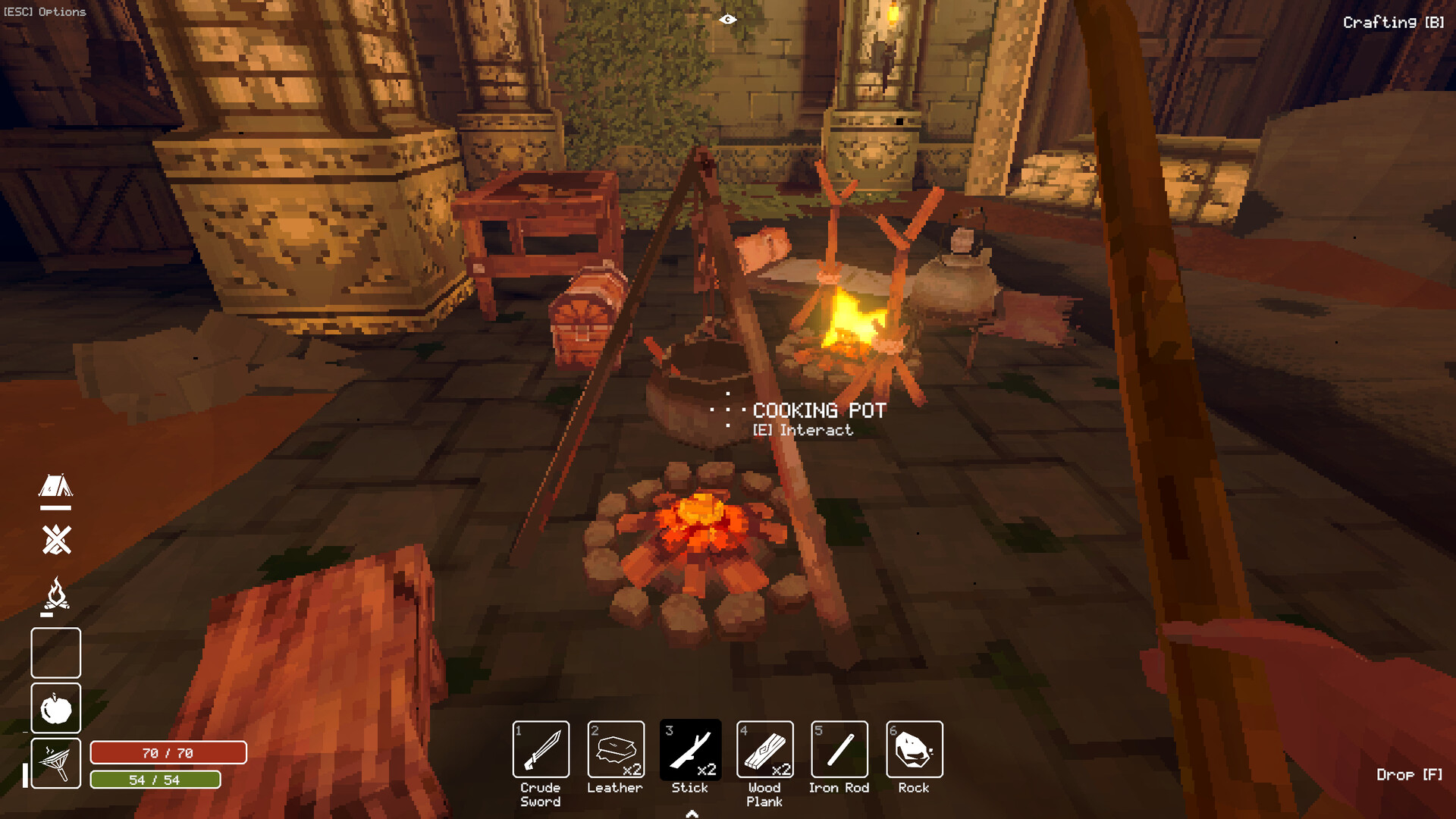
Official screenshot · Source: Steam store
On the Deep Dish Dungeon page on Steam, Behold Studios and Raw Fury describe a survival exploration crawler with Metroidvania gating, crafting, and online co-op for you plus up to two friends. The studio tells players to treat meals as progress, and to unlock recipes that change stats over time. Cooking is one of four pillars beside build, craft, and explore, so food fuels the trip without becoming the whole game.
The same page warns that a very small team designed the dungeon without hand-holding. Slow exploration and environmental detail are the intended tutorial. Player experience from a demo session matches that pitch. Beyond the torch the dark reads as a solid black wall. You hit an obstacle, test objects, improve a camp, then use that knowledge on the next corridor. There is no separate power ladder in these sources. Longer trips, opened bars, and meals that are still active when a fight starts are the scoreboard.
| Stage | What you do | What improves | If you skip it |
|---|---|---|---|
| Explore | Torch-lit rooms, doors, and drops | A mental map and key items | You stall or wander |
| Experiment | Wheels, planks, water, heat | One working solution | Fall damage or a soft lock |
| Camp | Fire, pot, chests, rotisserie | Food, storage, a safer exit | Spoiled meals and empty buffs |
| Push | Leave fed, with the new tool | The next gate | Hunger or missing gear stops you |
That loop is Deep Dish Dungeon progression in practice. The October 13, 2026 release is newer than the demo clears below. Treat every material limit as demo-confirmed unless this guide marks it as still unknown on 1.0.
Meals, Buffs, and Spoil Timers
Food is the consumable half of Deep Dish Dungeon progression. Official copy ties recipes to stat changes. Player experience is more specific: meals cover hunger and also act as buffs to health, stamina, and damage, which is what lets you stay in the dark longer. In that session, three food buffs could run at once, and each one expired on its own timer. Mushrooms were fading while pepper and apple were still fresh. No numeric values for those buffs appear in the sources, so do not chase a “best” dish by made-up percentages.
What you can eat
Community reports from a finished demo clear, plus one play session, support the recipes below. A later comment on that clear added two meat stews. Where the sources disagree on raw versus already-cooked inputs, both observations are listed instead of merged into a fake master recipe.
| Result | Inputs reported | Source note |
|---|---|---|
| Raw snack | Apple only | Community reports: nothing else was safe raw |
| Roasted food | Nearly any food on a rotisserie | Produces the roasted form of that item |
| Veggie dish | Wild pepper, mushroom, and apple | Community reports, cooking pot |
| Meat stew | Pepper, mushroom, or apple, plus raw meat | Same clear; plant plus meat |
| Stew from cooked goods | Cooked meat and roasted apple | Player experience; pot accepted them |
| Mushroom-fish stew | Butchered fish; two of that meat in the pot | Community follow-up |
| Drumstick stew | Butchered large bat; two drumsticks in the pot | Same follow-up, late demo |
Raw meat in those reports came from rats: build a trap, or grab the rat before it hides under debris. Fish and bat meat show up later, when you can butcher those creatures. Exact pot substitution rules are not fully written down. HOLD a complete “any cooked item works” rule. Test one new combination with food you can spare.
Pitfalls at the pot
- Spoilage is real. One session found stored food had gone bad and had to be thrown out. Cook for the next trip, not for a stockpile you will forget.
- Heat can ruin a meal. Food left on the fire long enough turned to coal in that same session. Treat that as an observed accident, not a verified coal recipe. Coal is listed as an item players could obtain, but the intended method is not documented here.
- There is no confirmed recipe book. Players asked for one because buffs and names are easy to mix up, especially when a pot result is not just “stew.” HOLD whether 1.0 added a log.
- Eat before you commit to a long corridor. Buffs are the only documented way to raise health, stamina, and damage at the same time.
Materials That Open or Close Crafts
A demo clear split the item list into things you can keep finding and things that do not respawn. That split is the crafting half of Deep Dish Dungeon progression: renewable junk builds the camp, and a handful of finite parts decide which recipes you will ever see.
| Item | Demo availability | Use that is actually documented |
|---|---|---|
| Stick, rock, plank, vines, scrap metal, hide, algae, coal | Gathered or produced | General crafts; scrap and planks also feed late weapon upgrades |
| Apple, mushroom, wild pepper, rat, raw meat | Gathered | Cooking, as in the table above |
| Clay | Not renewable in that clear | Water pot used four clay |
| Iron rod | Three, plus the camp cooking pot; not renewable | Gates a long craft list |
| Leather, chains, ragged cloth, log | Not found in that clear | Related recipes stayed locked |
| Carranca statue | Found | Effect unknown. HOLD |
Player experience gives one exact bill: four clay and one iron rod made a water pot at a fresh water source. Other recipe costs are not itemized. Do not assume every station costs one rod.
Community reports say these crafting-table results could not be made unless a starting iron rod was spent on them: nail, backpack, kettle, smelter, wood chest, barricade, workbench, water pot, wooden bridge, wooden bow, hammer, grappling hook, pouch, crude leather armor, scrap cape, medium sword, long sword, and grindstone. That is a menu, not a shopping list. Most of those items have no documented stat line in these sources. HOLD damage, armor values, and hook range.
Two conflicts are worth keeping straight:
- Hammer appears on that iron-rod menu, and a hammer is also picked up in the sewers. The pickup does not spend a rod. If rods are finite, the world hammer is the route that preserves them.
- One session deconstructed a chest and rotisserie, rebuilt a bonfire, and ended with doubled storage near water and a plank climb. The clear report still lists a wood chest as iron-gated. HOLD the exact cost of a second chest. Moving furniture you already own is the only storage trick both accounts can support.
Early inventory was six slots in one session, which makes backpack and pouch look important. Both sit on the iron-rod list, so they compete with the water pot and anything else you craft. A shield was a doubtful trade in that session because the torch was the only light. HOLD whether later gear lights the room without occupying that hand.
A Demo Route from Camp to the Prison Key
This is the hard Deep Dish Dungeon progression gate players actually described. It comes from community reports by people who finished the demo, with a June follow-up that corrected the nail and added food. It is not a patched 1.0 walkthrough. If a door, crank, or enemy is missing in your build, stop and treat the rest of the chain as unknown.
Set camp before the sewers
- Use the starting fire. Community reports place a cooking pot there already, separate from the three loose iron rods.
- Forage apples, mushrooms, and wild pepper. Catch rats with a trap or a fast grab.
- Roast backups on the rotisserie. Cook a veggie dish or a meat stew before a long push.
- Keep three different foods if you want the three-buff setup one player reported. Watch timers and spoilage when you get back.
- Spend clay and a rod on a water pot only when you have a water source you plan to reuse. Four clay and one rod is the only confirmed price.
- Save remaining rods until you know whether backpack, pouch, or another station matters more than a novelty weapon. Swords and armor are on the menu, but no clear says they are required to finish the demo route below.
- Planks can serve as ramps. One session avoided a bad fall by angling a plank up to a ledge. Deconstruct stations you can rebuild closer to that climb and to water.
Step-by-step: hammer and bars
Players called the hammer the sharpest pain point. Several thought they needed some other tool first, and nothing announces that you can swim.
- Reach the sewers.
- Find the room that already has a workbench.
- Pull the handcrank there.
- Enter the water and swim. Community reports say this works immediately and is required.
- Pick up the hammer.
- Break metal bars with it. Of the barriers noted in that clear (metal bars, goo, rock piles, spider web), only metal bars used the hammer.
- Burn the single breakable spider web with a torch, not the hammer.
- Goo, rock piles, and roots were not breakable with the tools that clear had. HOLD any 1.0 tool that opens them.
The first write-up said nails had no use. A follow-up corrected that: with the hammer you can fix a nail to a wall, then use rope on an out-of-reach sewer ladder. The same comment says other ways up exist. Do not spend a nail, or the rod that crafts it, until that ladder is actually your only route.
Step-by-step: keys, bat, and the forge
- Skeletons are scattered through the dungeon. They are not the forge gate.
- Scorpions, in that clear, showed up in a hall from the main room that drops steeply. They are a travel hazard, not a key drop that anyone documented.
- The moray eel appears in the sewers only after the water is raised and you are swimming. Do not treat dry corridors as eel-safe, and do not assume the eel is why the hammer is underwater.
- The large bat has one documented spawn. It guards the outside of the forge room.
- Bring the Iron Key to that forge area. Community reports say that is how you get the Prison Key.
- Butcher the bat if you want drumsticks for the late stew. Fish butchering is the parallel ingredient for the other extra stew.
- Near the end of the demo, a station upgrades weapons using scrap metal and wood planks. Further upgrades called for a grindstone, which those players could not obtain. HOLD grindstone recipes on the October 13, 2026 build.
Optional finds from that clear, not required for the tool chain: a gold bracelet after a wall torch was placed in a two-skeleton room behind a small-key door, and gold coins in the rafters of the main campfire room. The Carranca statue was picked up with no known function.
| Threat or barrier | Where players met it | What worked |
|---|---|---|
| Skeleton | Spread through the dungeon | No special tool documented |
| Scorpion | Hall from the main room into a steep drop | Location knowledge; no drop listed |
| Moray eel | Raised sewer water, while swimming | Avoid or fight in the water only |
| Large bat | Outside the forge | Iron Key exchange context; butcher for stew |
| Metal bars | General barriers | Hammer from the sewer pickup |
| Spider web | One breakable web | Torch |
| Goo, rocks, roots | Present in the demo | No break method. HOLD |
Co-op Habits and What 1.0 Still Does Not Confirm
Official co-op text frames the mode as sharing knowledge and looking after each other, not as a race. The useful split is information, not a role this guide can invent. One player can watch food timers and the pot while another maps a dark branch, then you compare notes at the fire before anyone spends a rod. The store page caps the party at you and two friends, with cross-platform online play, Steam Cloud, and achievements. A community thread asked whether four players had been added. Nothing in these sources answers that. HOLD a fourth slot.
Store data captured with this research showed Mostly Positive reviews, 76 percent of 114, on the day after launch. That says the crawl is landing with players. It does not confirm recipe lists.
These points stay unknown on the live game because the notes above are demo clears and one demo hour, not a 1.0 datamine:
- Whether clay, iron rods, leather, chains, ragged cloth, and logs are still finite.
- Whether goo, rock piles, and roots gained a tool.
- Whether the grindstone, a recipe book, or hands-free light shipped.
- Exact costs for every iron-rod recipe except the water pot.
- What the Carranca statue does, and what the Prison Key opens after the handoff.
- Any story objective beyond “unravel the enigma.” Demo players pushed forward with almost no stated goal. HOLD a chapter list.
If your 1.0 file contradicts a demo limit, trust the file. The durable habit still holds: learn the room, cook before you overextend, and do not spend a scarce part on a craft whose job you have not seen yet.
FAQ
How should I think about Deep Dish Dungeon progression on launch day?
Think in trips, not levels. Each trip should return with a new route, a meal plan, or a tool that removes one barrier. Health, stamina, and damage buffs come from food. Doors and bars come from keys and the hammer. Map memory is the upgrade that does not spoil.
What should I cook before I leave camp?
Eat an apple if you are empty and still at the fire, since it is the only food community reports called safe raw. For the trip, roast spare ingredients, then cook the veggie mix of wild pepper, mushroom, and apple, or add meat for stew. Player experience supports keeping three different foods active. Do not leave meals on the heat, and do not hoard them until they rot.
How do players get the hammer?
In the demo, community reports say to reach the sewers, pull the handcrank in the workbench room, swim, and pick the hammer up. Use it on metal bars. A craft recipe for a hammer also exists and depends on scarce iron rods, so the pickup is the path that saves those rods. Swimming is required and easy to miss. This sequence is not reconfirmed here for every 1.0 seed.
Are iron rods and clay still limited after October 13, 2026?
Unknown. HOLD. Demo clears could not generate more clay or iron rods, and many crafts existed only if those starting rods were spent. The full game has been out for a day relative to these notes. Check your own crafting menu before you treat a rod as unique, and prefer the sewer hammer over a crafted one until you know rods respawn.
Related Guides
Deep Dish Dungeon guide: Demo Craft and Routes
Practical Deep Dish Dungeon guide for the Steam demo: materials, cooking, tools, enemies, and which Prison Key steps are still unconfirmed.
Deep Dish Dungeon how to break bars: Hammer
Deep Dish Dungeon how to break bars in the demo: get the sewer hammer, swim after the handcrank, and see which obstacles still hold.
Deep Dish Dungeon how to cut roots: Demo Facts
No confirmed root-cutting tool appears in Deep Dish Dungeon community reports. Locations, crate clips, loot, and open HOLD items.
Deep Dish Dungeon cooking bench: camp cooking guide
Demo guide to the Deep Dish Dungeon cooking bench: campfire vs cooking pot vs workbench, known stews, iron rod limits, and burn pitfalls.
Deep Dish Dungeon cant play with friends: Co-Op Limit
Deep Dish Dungeon cant play with friends usually means the co-op cap: you plus three friends. Here is what is confirmed, and what is still unknown.